

The Surroundup
EARNINGS ARE WINNING THE BATTLE
- by Adil Mohammed, CFP®, CIM®, FCSI®
- September 14, 2026

Hey Everyone,
Adil here – well, another summer behind us.
Our first summer with both Arman and Zain at home. Always bittersweet.
On the one hand, if you asked me a week ago, the new school year couldn’t come fast enough.
If you ask me now, another summer behind us means another year of the kids growing up.
I’m not a particularly emotional person but watching your kids grow up hits differently.
We did our usual greatest hits, starting the summer with a trip to Barbados, which was part family vacation, part work conference. First time I’ve mixed the two and it was a blast.
From there, we did a bunch of smaller day trips – Toronto (just like their father, they love the city), a Jays game, Centre Island, Niagara Falls, Canada’s Wonderland, the Zoo, their first GO Train and streetcar rides, and their first visit to the National Bank Open.
And just like that, we no longer have daycare babies.
My oldest is heading into Grade 1 and my youngest is starting Junior Kindergarten.
Not sure when that happened.
Before I jump in, if you enjoy these posts and think someone else may find them useful, feel free to share.
Okay, let’s get into it…
CANADA-U.S. TRADE WAR
Let’s start at home. Given that we’re all Canadians, this one hits close to home.
It’s important, though, to put this into context.
I view this as LESS of a market/portfolio story and MORE of a Canadian economy story.
Something you’ve heard me preach over and over again: the stock market is not the economy, and the economy is not the stock market.
This is particularly true in Canada.
It’s easy to assume that if the Canadian economy is struggling, our investment portfolios must be struggling as well, and vice versa. That’s simply not the case.
The Canadian stock market is not a complete representation of the Canadian economy. Many Canadian companies operate globally and, most importantly, our clients’ portfolios are globally diversified.
So while tariffs could have a meaningful impact on certain Canadian industries, businesses and workers, that doesn’t necessarily translate into a significant impact on your investment portfolio.
That said, as Canadians, this still matters.
I’ve linked an article from CI Global Asset Management entitled “U.S.-Canada Tariffs: Three Scenarios and Their Implications.”
A few key takeaways:
- The direct economic impact of the latest tariff escalation appears manageable.
- The bigger risk isn’t necessarily the tariffs themselves, but how long the uncertainty lasts and whether the situation escalates further.
- The expected impact to Canadian GDP is less than 0.5%, the net tariff rate rises to approximately 6%, and roughly 80% of Canadian exports to the U.S. remain tariff-free.
- A negotiated resolution remains the most likely outcome.
The last point is probably the most important.
I’ll leave this here as the linked paper does the heavy lifting for those who are interested.
The paper itself makes essentially the same point: prolonged uncertainty affecting confidence, investment and business decisions is potentially more consequential than the direct tariff math.
SO, WHAT’S ACTUALLY GOING ON IN MARKETS?
Rather than write another thousand-word essay, I thought I’d tell most of the story through pictures and charts.
And the first chart tells you a lot.
Despite everything you’re reading in the news, markets are having a pretty good year.

As you can see, most major asset classes have generated positive returns this year, with several equity markets producing double-digit returns.
Commodities have been the standout, up nearly 42%, while emerging markets are up more than 23%.
Bitcoin has been the major outlier, down approximately 12%.
But the bigger story for me is the breadth of the returns.
THE BULL MARKET IS GLOBAL
If you’re thinking this is another year where the U.S. is doing all the heavy lifting, that’s not the case.
The bull market is global.

For those interested, the Canadian stock market is up about 16% as of early September.
Similar to last year, diversification continues to work.
And that’s exactly what we want.
We don’t want to build portfolios that depend on one country, one sector or seven companies having a good year.
SO WHAT’S DRIVING THE MARKET?
Earnings.
I know I probably sound like a broken record.
I’ve been writing about this for the better part of a year. See here, here and here.
But there’s a reason I keep coming back to it.
Company earnings continue to drive markets.

A quick explanation of what you’re looking at.
Forward earnings estimates are simply what analysts expect companies to earn over the next 12 months.
Don’t get caught up in all the numbers. Look at the direction of the lines.
Particularly that blue line representing the S&P 500.
It’s propelling higher.
Simply put, companies continue to make more money than analysts expected, forcing analysts to continually raise their forecasts.
And ultimately, one of the most important long-term drivers of stock prices is exactly that:
Earnings.
AND IT’S NOT JUST TECHNOLOGY
I know what you’re thinking. “Sure Adil, but isn’t technology driving all of this?”
Well…yes and no.
Technology is clearly leading the way, with earnings expected to grow a whopping 43.4% over the next 12 months.
But look at the rest of the chart.
Every single sector is expected to grow earnings.

Even the lowest-growth sector is still expected to produce positive earnings growth.
That matters.
This isn’t simply a technology earnings story anymore.
HERE’S THE INTERESTING PART: VALUATIONS HAVE FALLEN DESPITE RISING MARKETS
Given the strong stock market returns this year, you’d naturally assume valuations have moved higher as well.
They haven’t.
Look at the right-hand side of the chart.

Despite stocks moving higher, forward valuations have actually come down.
This does not mean stocks are cheap.
It means earnings expectations have been rising faster than stock prices.
In other words, this bull market has been driven primarily by improving fundamentals and earnings growth – not simply investors becoming willing to pay higher and higher prices for stocks.
REMEMBER THE MAGNIFICENT SEVEN?
A few years ago, seemingly every conversation about the stock market came back to the same seven companies:
Apple. Microsoft. Amazon. Nvidia. Meta. Alphabet. Tesla.
The Magnificent Seven.
The argument was that these seven companies were responsible for essentially all of the market’s returns.
Well…take a look at this.
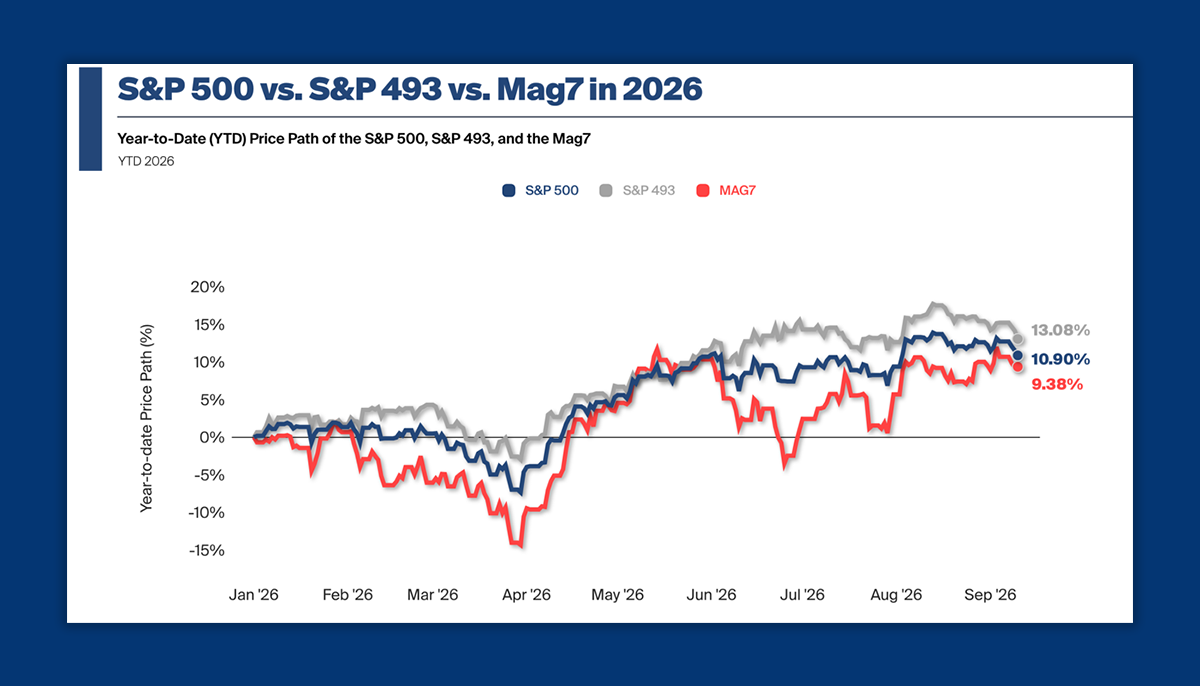
So far in 2026:
S&P 493: +13.1%
S&P 500: +10.9%
Magnificent Seven: +9.4%
In other words, the other 493 companies are outperforming the Magnificent Seven.
That’s a very different market than we had a few years ago.
Again:
Broader participation.
And that’s healthy.
Okay, I’ll stop there.
Let’s flip the script.
Markets are strong. Earnings are strong. Participation is broadening.
So… what could derail it?
1. September
Historically, September has been the weakest month of the year for U.S. stocks. That doesn’t mean stocks will fall this September.
But a little more volatility from here wouldn’t exactly be surprising.
2. Midterms
U.S. midterm elections are approaching in November.
As we get closer, uncertainty around control of Congress could add another layer of volatility.
Again, markets don’t necessarily care which party wins. They generally prefer certainty.
3. The $550 billion AI question
AI continues to be an enormous driver of investment and economic activity. In particular, we’re in the middle of an AI capital expenditure boom, with hundreds of billions being spent on data centres, chips, servers, power and other infrastructure.
The obvious risk?
What if the revenue doesn’t justify the spending?
AI adoption can continue and still turn out to be less profitable than investors expect. If that happens, you could end up with too much computing capacity and poor returns on hundreds of billions of dollars of investment.
Not to mention, some of this infrastructure buildout is increasingly being financed with debt.
Again, none of this means the AI boom is about to end.
It just means expectations are high – and the higher the expectations, the less room there is for disappointment.
4. Bond yields
Think of a U.S. government bond yield as essentially the interest rate the U.S. government has to pay investors to borrow money.
If investors were previously willing to lend the government money at 4%, but now say, “No thanks, I need 5%,” yields rise.
Why?
Inflation is part of it. If inflation is higher (as a result of higher energy prices or tariffs for example), investors need a higher return just to maintain their purchasing power.
Government debt is another factor. The U.S. needs to borrow enormous amounts of money, meaning it has to issue more bonds (a.k.a. debt).
More supply means investors can demand a better return for lending the government money.
Why does that matter for stocks?
Because bonds compete with stocks.
If investors can earn an attractive return from relatively safe government bonds, they may be less willing to pay high prices for stocks
Rapidly rising yields can therefore become a headwind for stock prices – particularly more expensive growth and technology companies.
5. Earnings
And finally, the biggest risk to the earnings story…
Earnings.
At some point earnings growth will slow. That’s inevitable.
The question is whether companies continue to meet the very strong expectations currently being built into stock prices.
If earnings disappoint, the fundamental support that has helped markets overcome so much bad news becomes weaker.
That’s probably the risk I’m watching most closely.
SO… SHOULD WE BE WORRIED?
I just outlined some very real risks.
And it’s important that you know what we’re watching.
But it’s equally important to remember:
There are ALWAYS risks.
AI spending. Government deficits. Tariffs. Wars. Elections. Inflation. Interest rates.
The list changes, but the existence of risk doesn’t.
There’s an old expression that markets “climb a wall of worry.”
That’s exactly what we’re seeing.
And ironically, the thing that eventually causes the next meaningful market decline may not even be on the list above.
It’s often the thing nobody sees coming.
COVID. Russia invading Ukraine. Liberation Day. The U.S.-Iran conflict.
Nobody had those on their bingo card.
Will we experience another market correction?
Absolutely.
Corrections are a feature of markets.
Do we know when the next one is coming?
No idea.
And anyone who tells you otherwise doesn’t know either.
Our job isn’t to predict or avoid every correction.
Our job is to make sure you’re in the right portfolio from a risk perspective, remain properly diversified, have your short-term spending needs accounted for, and – most importantly – stick to the plan when markets inevitably get uncomfortable.
Here’s the main takeaway:
Right now, earnings are winning the battle.
There is no shortage of economic, political and geopolitical risks.
But corporate earnings have been strong enough to overpower much of that noise.
We’re in an earnings boom.
It won’t last forever.
As always, I’m here if you need me and look forward to connecting with you soon.
Adil Mohammed, CFP®, CIM®, FCSI®
Wealth Advisor, CI Assante Wealth Management Ltd.
Mutual Fund Dealer
The opinions expressed are those of the author and not necessarily those of CI Assante Wealth Management Ltd. This material is provided for general information and the opinions expressed and information provided herein are subject to change without notice. Every effort has been made to compile this material from reliable sources however no warranty can be made as to its accuracy or completeness. Before acting on the information presented, please seek professional financial advice based on your personal circumstances. CI Assante Wealth Management Ltd. is a Member of the Canadian Investor Protection Fund and the Canadian Investment Regulatory Organization.